01 WooCommerce
WooCommerce
The previous website could sell products, but it was not a made-to-measure commerce system. The constraint was the ecommerce model itself, not simply the look of the store.

Lustalux · Commerce platform
Rebuilding a commercial brand and made-to-measure ecommerce platform
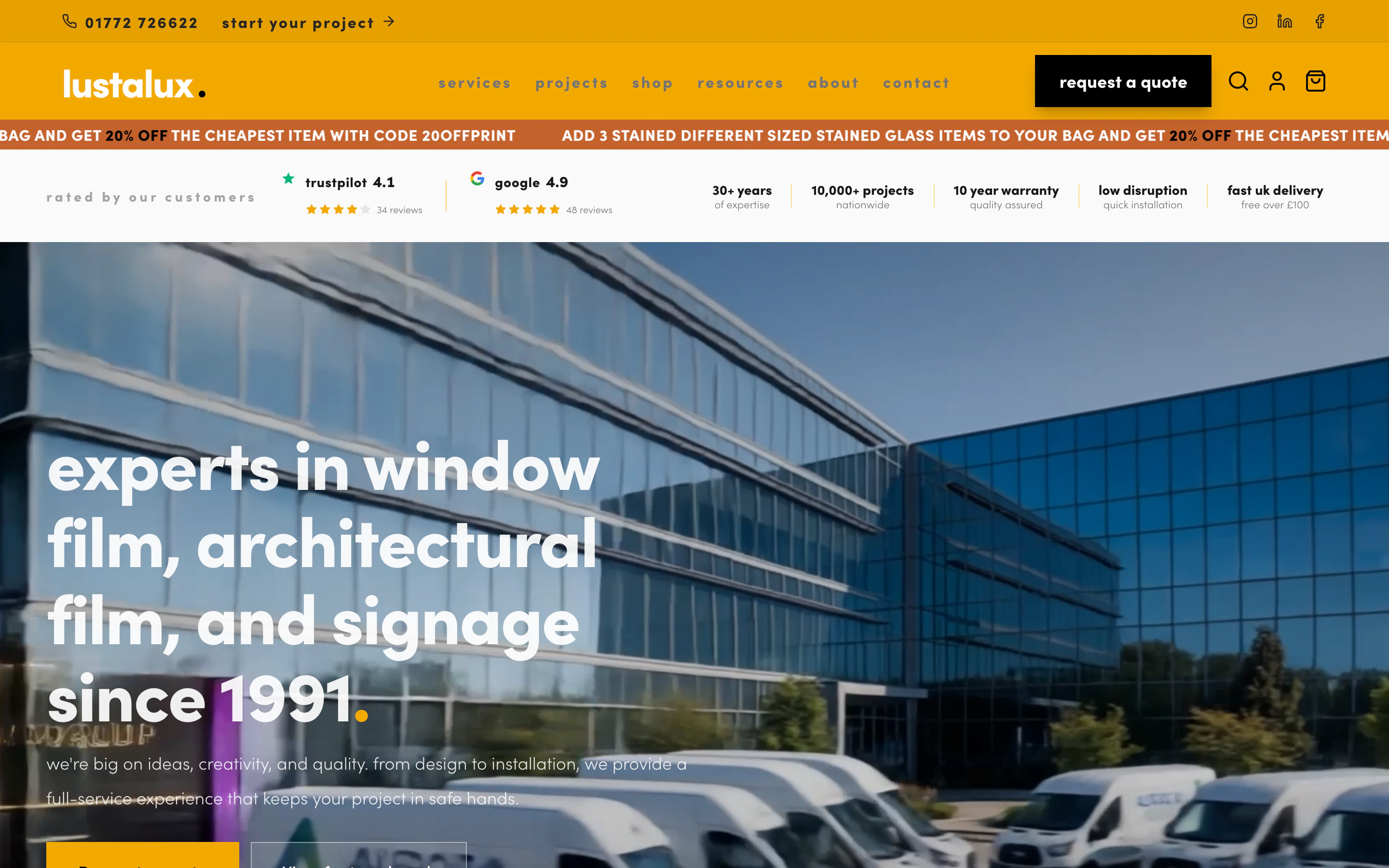
We rebuilt Lustalux around a custom Next.js storefront and Saleor commerce platform, combining commercial installation services with Lustalux Direct while preserving the organic search value accumulated by the previous WooCommerce website.
Role
Solo full stack delivery
The project at a glance
1,004
17
84
9 months
1
The business problem
One website. Two businesses. A completely new commerce foundation.
Lustalux needed one digital platform capable of supporting commercial service enquiries, architectural film, window film, signage, sector content, location content, projects, educational resources, and a direct ecommerce business selling configurable film online.
The challenge was not simply to put products into a shopping cart. Products could depend on width, height, shape, colour, print configuration, product type, area and commercial pricing rules.
That created a fundamentally different commerce problem from a conventional SKU based store.
The work combined two distinct jobs: a commercial brand and lead generation website for installation services, and a made-to-measure ecommerce platform for Lustalux Direct.
The product also needed to replace an established WooCommerce implementation without discarding years of organic search equity.
Lustalux had to present commercial installation services credibly. Survey, specification and enquiry journeys needed to feel like a specialist contractor, not a generic product catalogue.
At the same time, Lustalux Direct had to sell made-to-measure products online. Staff needed operational control without a separate CMS sitting beside the store.
The fourth constraint was search. Moving away from WooCommerce could not mean throwing away the destinations, content and URL equity the previous website had already earned.
The ecommerce model was the architectural constraint. Until configuration, quoted pricing and cart identity were treated as product problems, the rest of the website could not be finished honestly.
Made to measure commerce
Traditional ecommerce platforms expect a product, a variant, a quantity and a price.
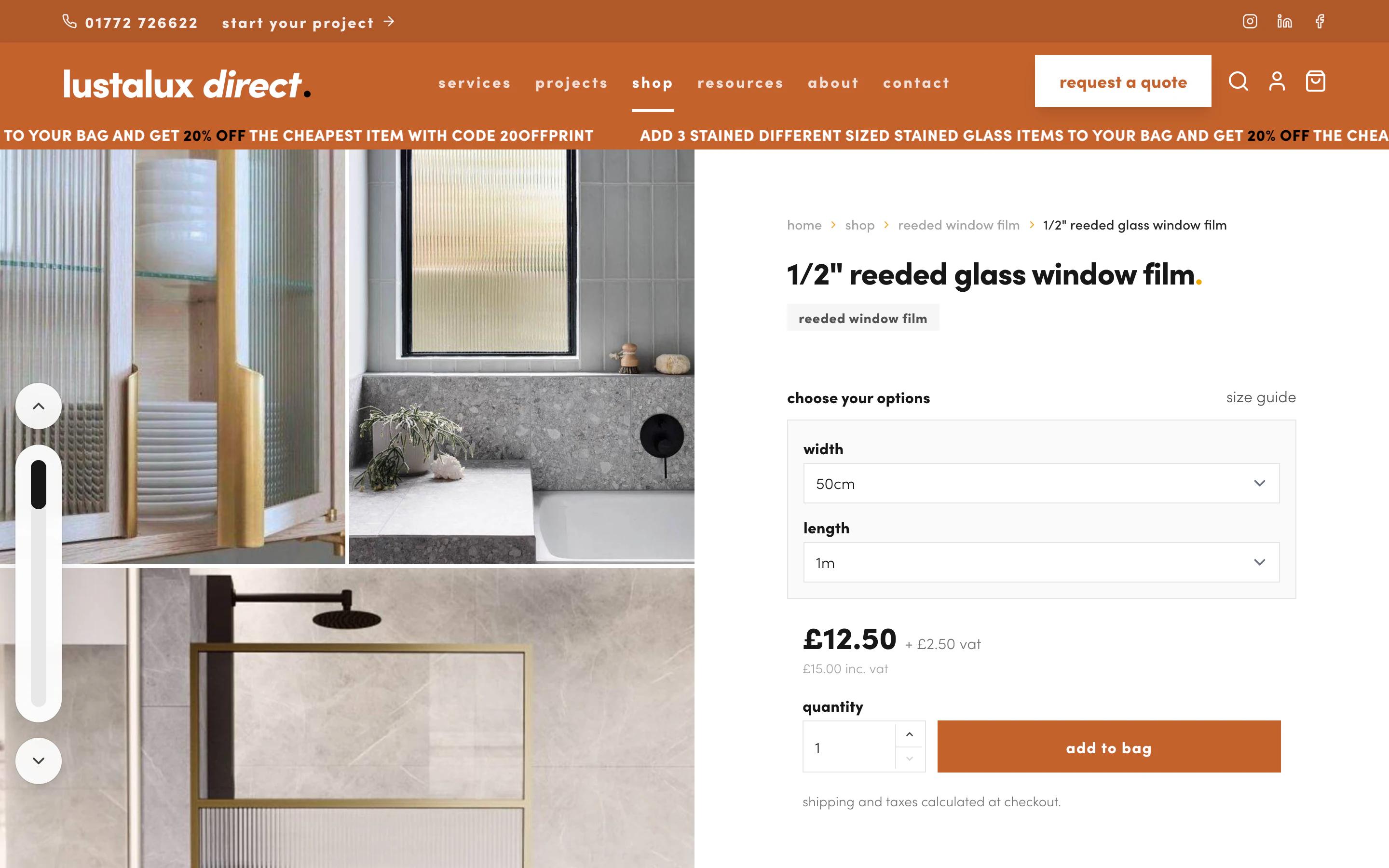
Lustalux Direct needed combinations such as product, width, height, shape, colour, print, area and a calculated price.
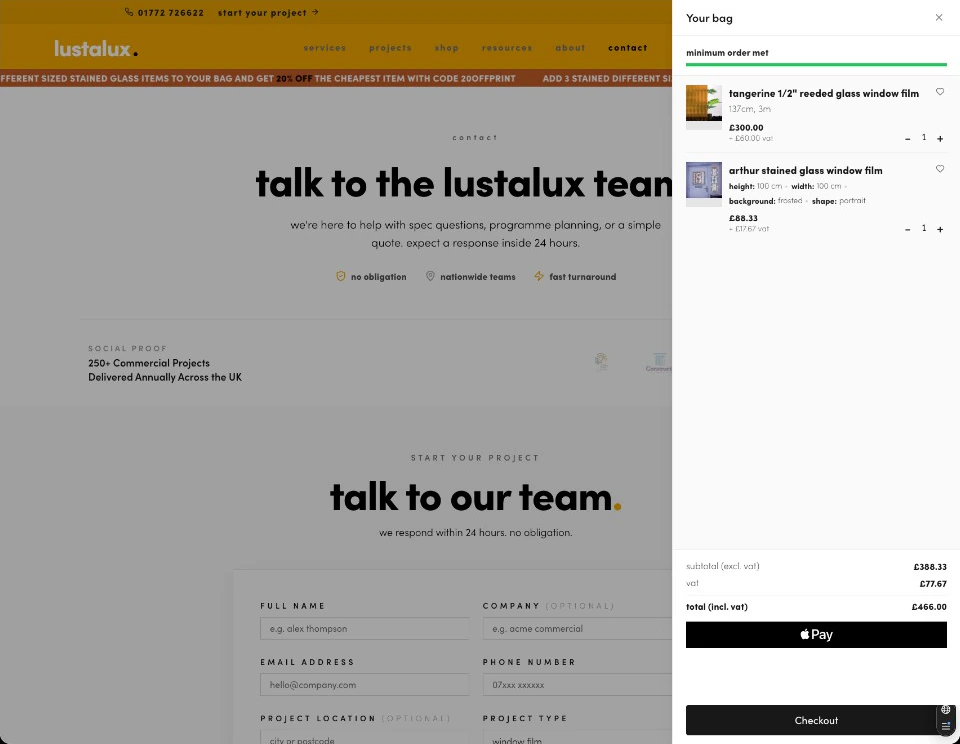
Each configured piece needed to remain distinct even when based on the same underlying product variant. Two cuts of the same film are not the same line in a bag.
That is why a conventional cart model was not sufficient. The storefront had to quote, remember and purchase configuration, not only catalogue SKUs.
Dimensions, configuration, product imagery, calculated price and the purchase action sit together. The interface is the commerce model, not a skin over a static catalogue.
Custom pricing
A quoted price is produced after the piece exists as a specification. That quote then becomes a custom cart line before checkout is created.
Product
The customer starts with a film, finish or printed range.
Dimensions
Width, height and shape define a unique cut.
Configuration
Colour, print and product type complete the specification.
Server quote
Price is calculated from commercial rules, not a static SKU.
Custom cart line
The configured piece stays distinct in the bag.
Checkout
Only then is the commerce checkout materialised for payment.
Custom cart
Conventional Saleor checkout lines are associated with product variants.
For made-to-measure film, two differently sized cuts of the same material cannot be allowed to collapse into the same configured line.
The solution was a custom cart capable of preserving configuration and quoted pricing independently. Only when the customer moves towards payment is the appropriate commerce checkout materialised.
The customer still sees a familiar bag and checkout. Underneath, the platform refuses to treat unique pieces as interchangeable stock.
Two configured pieces stay as separate bag lines, with their own dimensions, options and quoted pricing, until checkout is created.
Product page modes
The commerce platform supports more than one product configuration experience.
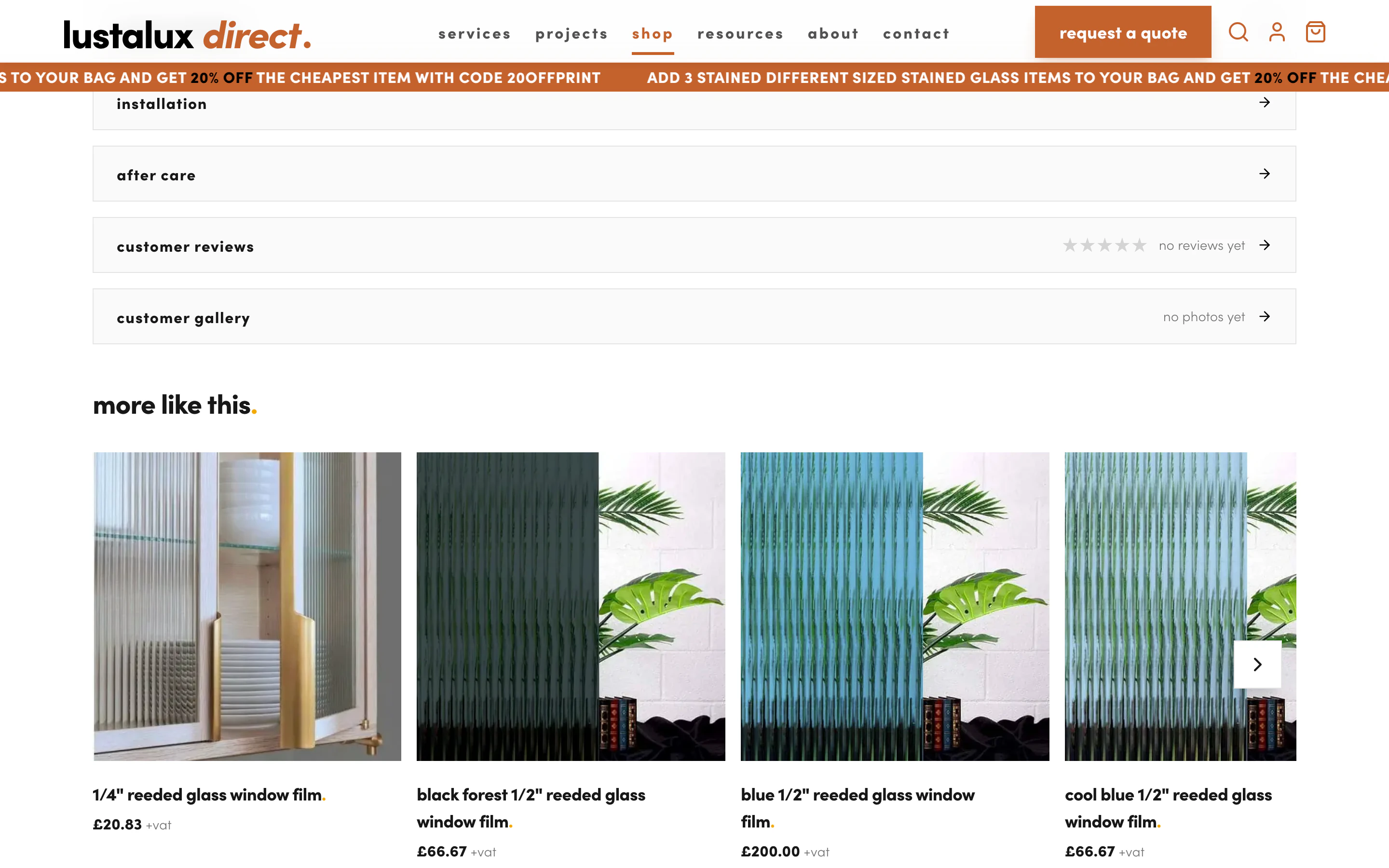
Made-to-measure products collect dimensions and options. Other products use preset dimensions. Printed ranges add colour and print configuration on top of the same commerce model.
Product metadata determines the appropriate experience. The storefront adapts around product logic rather than forcing every product through the same template.
01
Width, height and shape produce a unique piece with a calculated price.
02
Selected products use prepared sizes rather than free configuration.
03
Print and colour options sit on top of the same commerce model.
Brand and commercial website
The project is not only ecommerce.
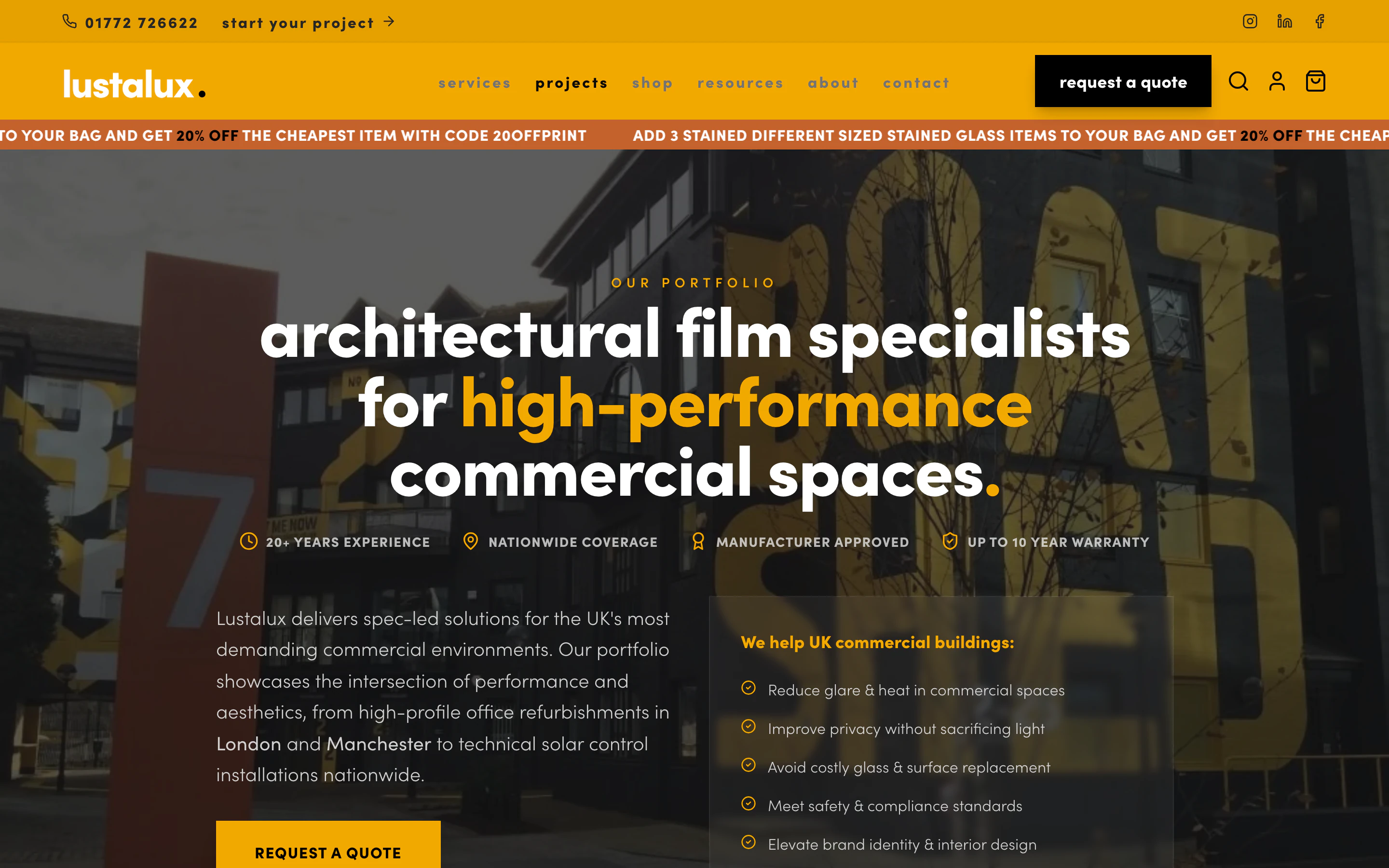
The same Next.js platform serves service pages, sector pages, location pages, case studies, resources, trust elements, installation process, brochure content and lead generation journeys.
High intent commercial enquiries and direct ecommerce sit in one public website. The brand does not split in two simply because the buying motions are different.
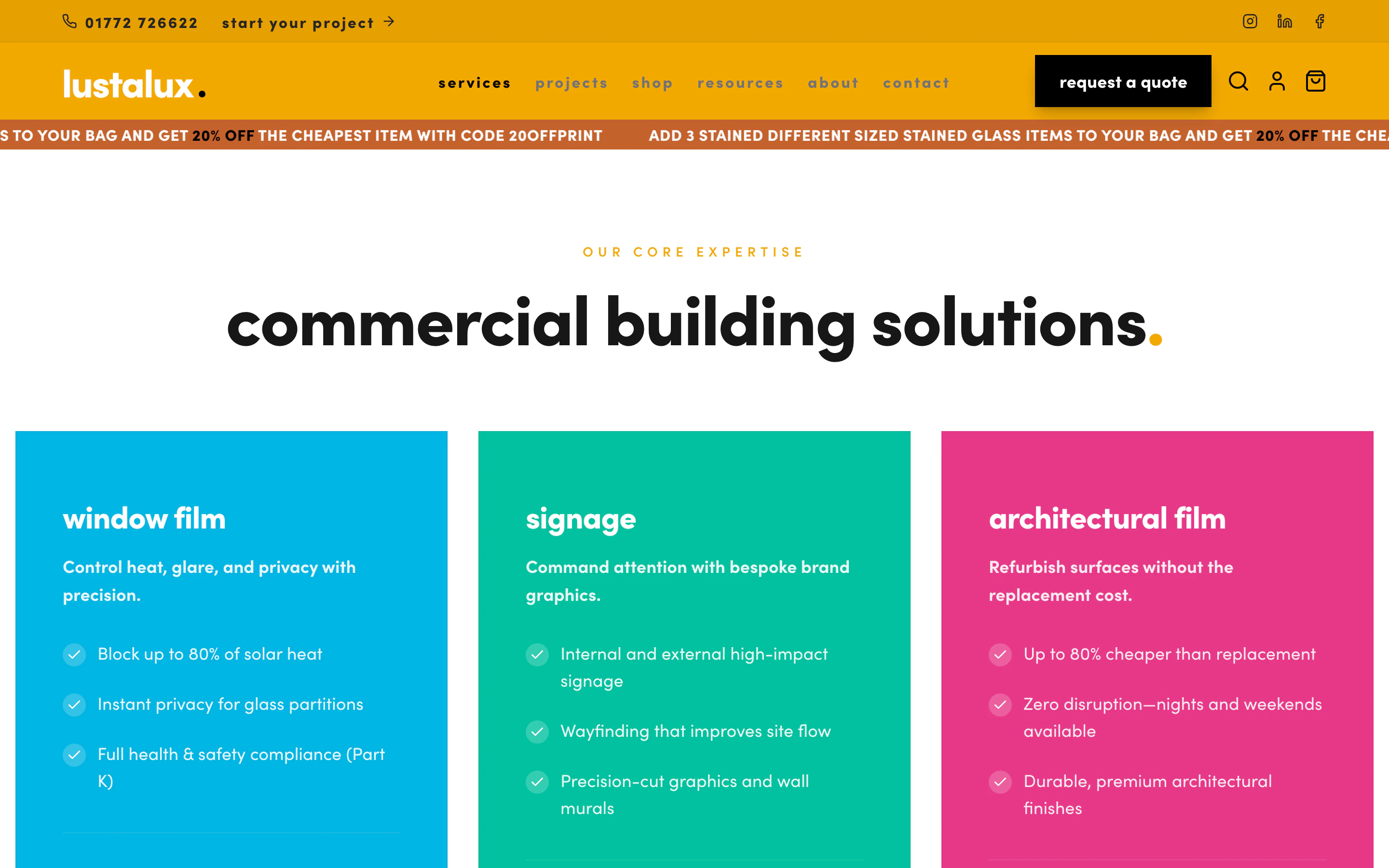
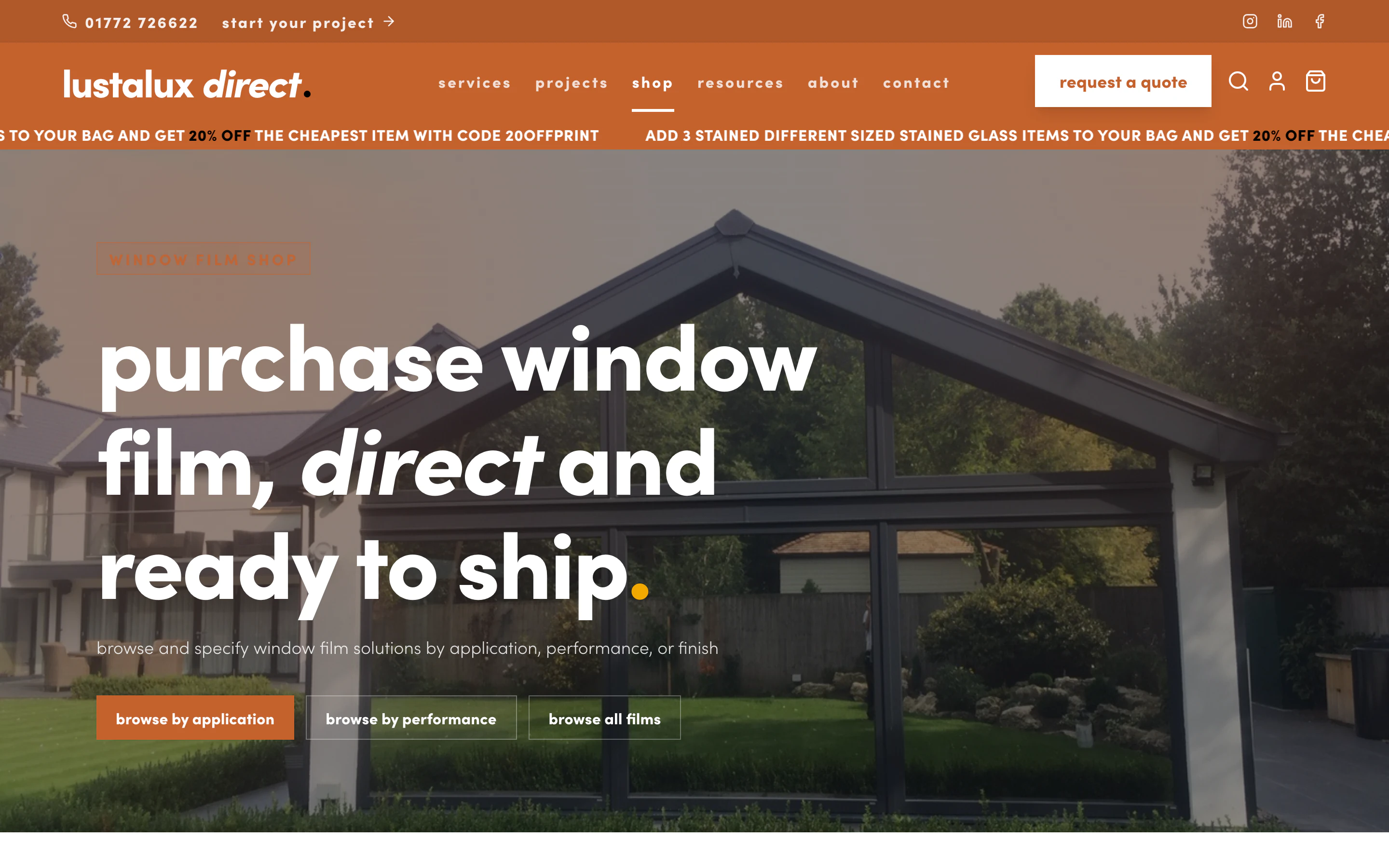
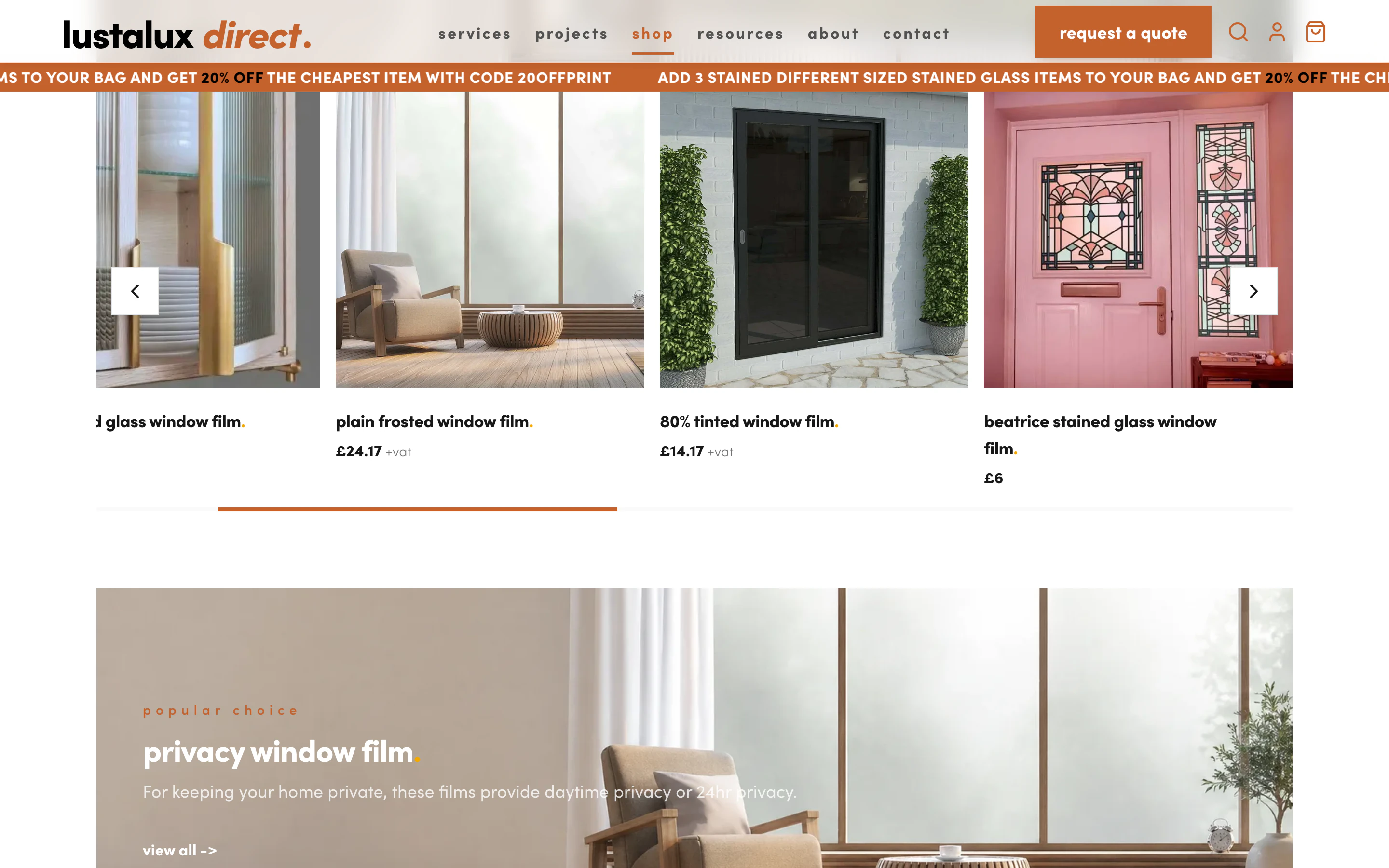
Two businesses. One platform.
Lustalux platform
Commercial services, content and made-to-measure ecommerce from one Next.js storefront.
Survey
Specification
Commercial enquiry
Installation
Choose film
Configure size
Price
Checkout
Delivery
SEO migration
Migrating away from WooCommerce was not simply a product data migration. It required preserving URL equity and established content.
The SEO architecture included legacy URL handling, 301 redirects, 410 responses, canonical URLs, query stripping, structured data, resources migration, metadata preservation, sitemaps, indexation controls, runtime junk prevention and Search Console follow up.
The new storefront includes engineering specifically designed around URL continuity and index quality. We do not treat rankings as a promised outcome. We treat continuity as a platform requirement.
Legacy WooCommerce URL
The previous store had years of indexed destinations.
Migration mapping
Each path was classified as keep, redirect or retire.
Redirect or retained page
301, 410 or a living Next.js destination.
New Next.js page
The public experience is rebuilt, not merely restyled.
Canonical and structured data
Index quality is treated as part of the platform.
A migration is not complete when the products move. It is complete when the accumulated value of the old website moves with them.
Content pipeline
The site includes substantial informational and SEO focused resources.
Editorial content is structured, passed through a build pipeline, and published as resource pages with metadata, structured data, related products and internal links.
Content is not an afterthought beside the shop. It is a controlled system inside the same storefront.
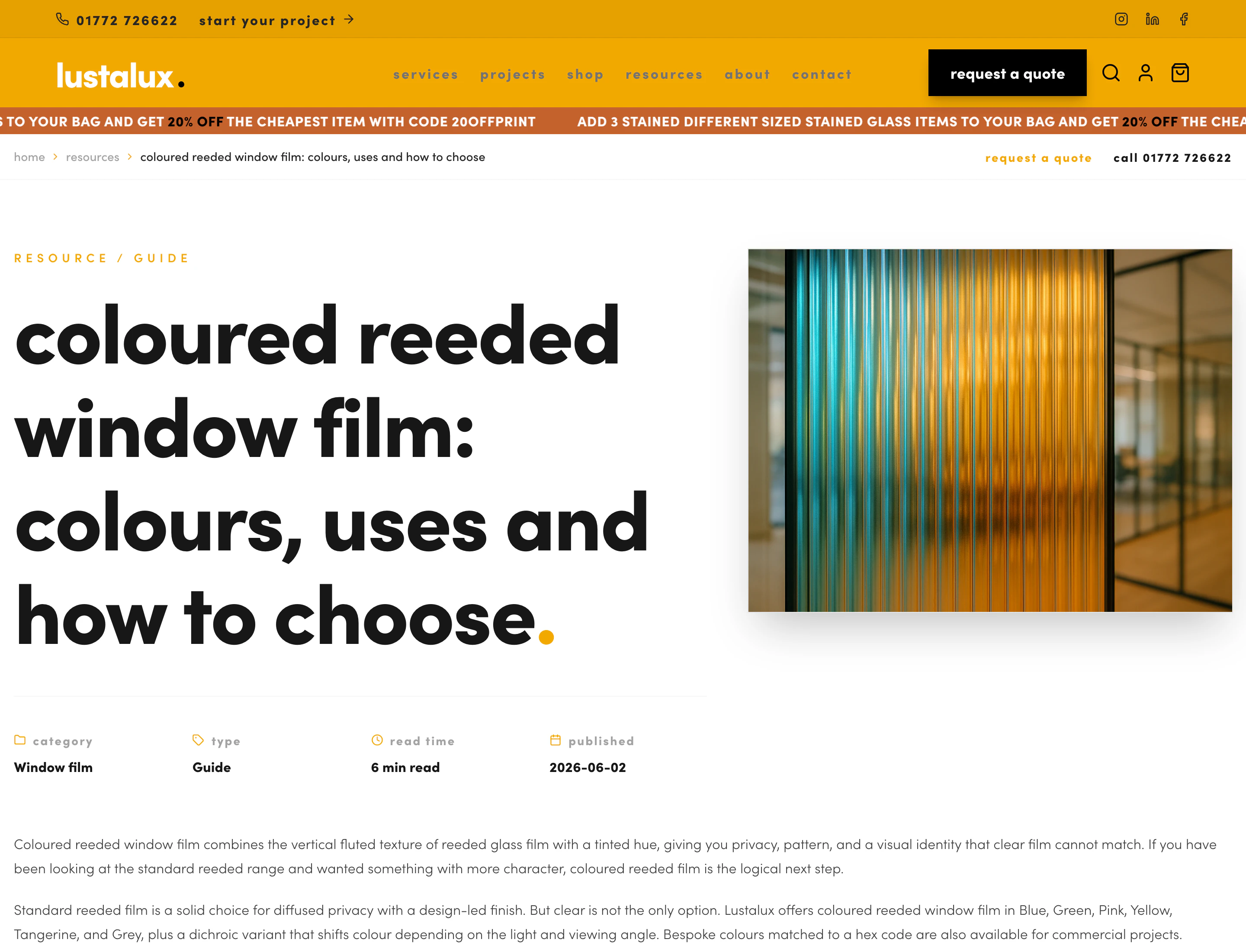
Staff operability
The commerce platform needed to give Lustalux staff control from the Saleor Dashboard.
Product and category metadata became a configuration layer for the storefront. Staff can influence featured collections, merchandising, navigation, hero content associations, suggested products, category visibility, sort priority, shop navigation imagery and product presentation.
The applications mount into the Saleor Dashboard, so staff remain within one operational environment. The result is one commerce control centre for the business, not a scatter of disconnected microservices.
01 Saleor Dashboard
Staff stay inside one operational environment.
02 Product and category configuration
Metadata becomes the storefront control layer.
03 Live storefront result
Merchandising, navigation and presentation update without a separate CMS.
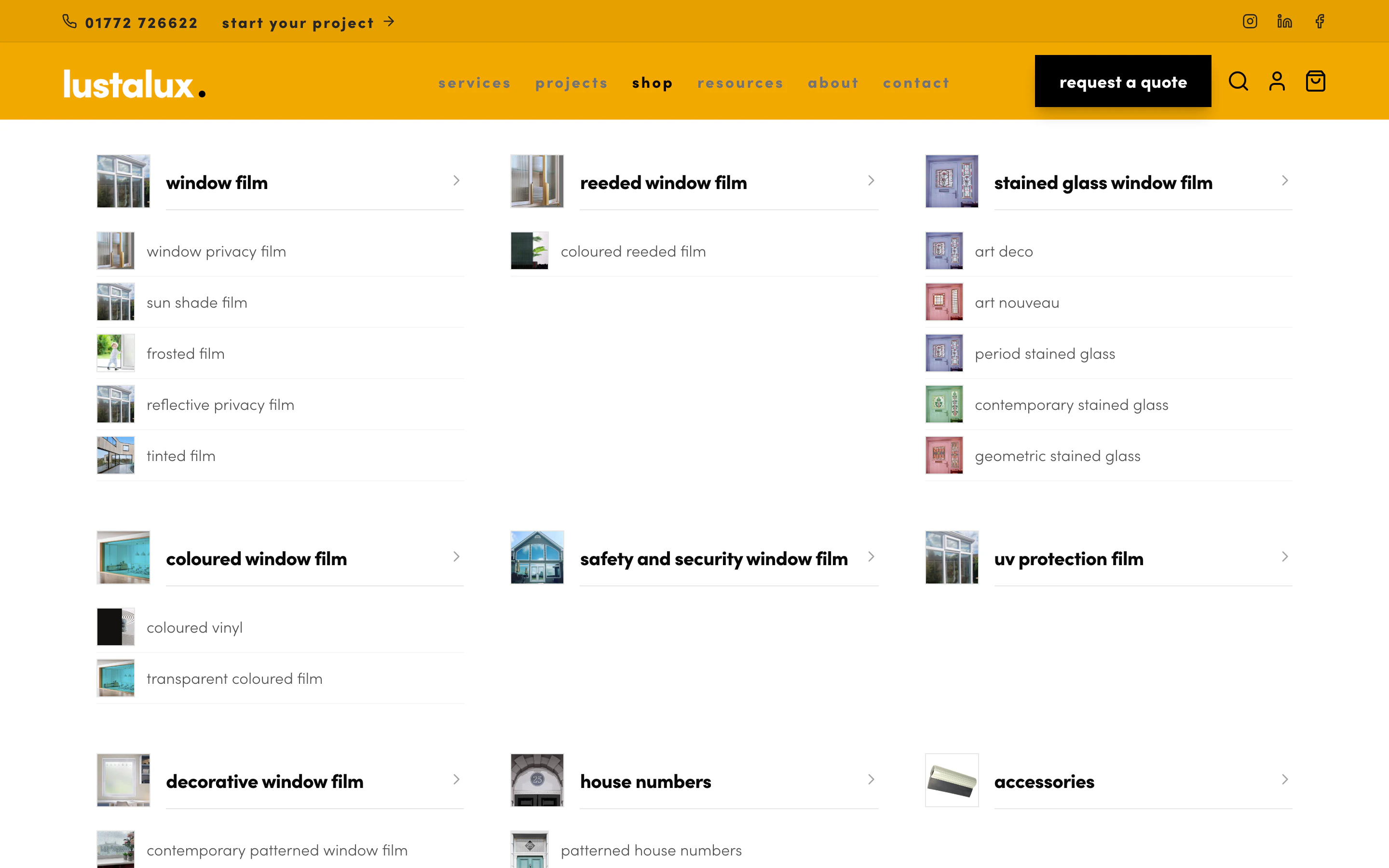
Saleor platform
Saleor provided the open source commerce foundation, including products, variants, channels, orders, checkout, customers, dashboard and GraphQL commerce APIs.
Our work was the Lustalux product layer: the custom storefront, custom applications, migration, pricing systems, SEO architecture, integrations, deployment infrastructure and operational tooling.
That distinction matters. The commerce foundation was Saleor. The Lustalux system built on top of it is the work demonstrated in this case study.
Foundation
Products
Foundation
Variants
Foundation
Channels
Foundation
Orders
Foundation
Checkout
Foundation
Customers
Foundation
Dashboard
Foundation
GraphQL commerce APIs
Seventeen applications
The applications mount into the Saleor Dashboard. Staff stay in one operational environment. Buyer Lens supports reviews, ratings, gallery content, review invitations and product navigation imagery. Intelligence brings selected commerce, analytics, advertising and search performance signals into that same environment.
Commerce operations
Growth
Platform intelligence
Operations
Checkout and payments
The purchase experience had to carry a configured piece through shipping eligibility, UK postcode handling, promo codes, product notes, Stripe, Apple Pay, Google Pay and order confirmation.
The wider platform then connects that commerce order with operational systems such as shipping and customer communications.
The flagship story is still product and platform engineering. Payments and fulfilment are part of the same operating model, not a logo wall beside it.
Architecture
The work did not begin as a finished system diagram. It evolved as the unusual constraints became unavoidable.
WooCommerce could not express made-to-measure identity. Saleor provided a serious commerce substrate. The custom Next.js storefront made brand and Direct one public product. Custom pricing and cart logic made configuration purchasable. The operational app ecosystem made the storefront operable. Intelligence and growth infrastructure made the platform improvable.
WooCommerce
Saleor commerce foundation
Custom Next.js storefront
Custom pricing and cart
Operational app ecosystem
Intelligence and growth infrastructure
01 WooCommerce
The previous website could sell products, but it was not a made-to-measure commerce system. The constraint was the ecommerce model itself, not simply the look of the store.
02 Saleor commerce foundation
Saleor provided products, variants, channels, orders, checkout, customers, dashboard and GraphQL commerce APIs. That foundation was the starting point, not the finished Lustalux product.
03 Custom Next.js storefront
The storefront had to present commercial installation services and sell configurable film without splitting the company across two unrelated websites.
04 Custom pricing and cart
Conventional variant lines would collapse two differently sized cuts of the same film. A custom cart preserves configuration and quoted pricing until checkout is materialised.
05 Operational app ecosystem
Seventeen Saleor applications extend the dashboard into merchandising, fulfilment, pricing, reviews, reporting and platform management.
06 Intelligence and growth infrastructure
Feeds, reviews, reporting and selected commerce and marketing signals sit inside the same operational environment rather than as disconnected extras.
Each stage answered a specific failure of the previous one.
The wider system
Experience
Browser
Next.js storefront
Commerce
Saleor GraphQL
Custom commerce services
Cart infrastructure
Payments
Operations
Saleor Dashboard
Custom applications
Delivery
Cloud delivery
Analytics
CI/CD
Product evolution
The project narrative matters more than commit count. March was the peak implementation period, when production commerce, the custom cart and checkout hardening came together.
January 2026
The Saleor storefront was forked into a Lustalux product. Brand implementation, made-to-measure configuration and dynamic pricing began here.
February 2026
WooCommerce migration, redirect architecture, payments and custom pricing services moved the project from a storefront into a platform.
March 2026
Production commerce, custom cart evolution, checkout hardening and analytics defined the peak implementation period.
April 2026
The commercial installation journey, staff tooling and reliability work bound the brand website to the commerce platform.
May 2026
URL continuity, the resources pipeline, structured data and canonical architecture treated search equity as an engineering problem.
June and July 2026
Reviews, product feeds, reporting and shipping integration extended the platform beyond the first live commerce cut.
August and September 2026
Wallet payments, merchandising improvements, Intelligence and operational hardening closed the nine month build period.
Solo engineering
Delivery included product decisions, interface design, frontend engineering, backend services, commerce architecture, Saleor applications, migration tooling, SEO engineering, infrastructure, CI/CD and operational documentation.
That breadth is the point of the project, not a claim that one person authored Saleor itself.
The commerce foundation was Saleor. The Lustalux system built on top of it is the work demonstrated in this case study.
Quality and reliability
Staging and production parity, automated validation, application contract verification, health checks, post deployment verification, Playwright smoke tests, pricing tests, application reliability tooling and explicit production deployment safeguards were treated as product work.
The storefront had to be changeable after launch. Reliability was the condition that made continued shipping possible.
Delivery
Visual language
Sofia Pro, yellow, black, grey, departmental colour systems, sharp rectangles and circular accents were already the brand. Direct has its own supporting palette. The work was to make that identity hold across commercial services and commerce.
What we delivered
Technology
Storefront
Commerce
Platform
Infrastructure
Growth and quality
The product
The public website combines commercial installation services with Lustalux Direct on the Lustalux domain.
The result
The resulting platform is live on the Lustalux domain. It combines commercial lead generation and direct ecommerce on a custom Saleor architecture.
It supports made-to-measure pricing and checkout, gives staff control through Saleor, and preserves the migration path from WooCommerce.
It operates with staging and production delivery processes, supports payments including mobile wallets, and supports a growing ecosystem of custom operational applications.
Lustalux now has a digital platform capable of selling both expertise and product. The same system supports customers looking for a complete commercial installation and customers who want to configure and purchase material directly.
This was not a WooCommerce reskin. It was a rebuild of how the business operates online.
A custom commerce platform built around the business.
Start a project
When products, pricing, content, operations and existing search visibility all need to work together, ecommerce becomes a software engineering problem.