
Mobile app development
Mobile App Development
Professional mobile app development gives your business an application people can open, understand and keep using, on the devices they already carry.
Mobile app development built around how people actually use the product
We design and develop mobile applications for businesses, startups and product teams that need more than a wrapped website. That includes customer apps, booking and membership products, internal tools, and apps that have to talk to systems you already run.
Our mobile app development services cover product planning, iOS and Android work, UX, backend services, integrations, testing and the development that follows launch. This page is about mobile products. A marketing website or a multi tenant SaaS platform is a different brief.
01
What mobile app development involves, and who it is for
Mobile app development is the work of planning, designing and building software for phones and tablets. It includes the screens people use, the journeys between them, accounts, notifications, and the backend that stores data and talks to other systems.
Custom mobile app development is for organisations whose product or process does not fit an off the shelf application. A booking flow, a membership model, a field team, or a customer portal often needs behaviour that a generic app cannot provide. App developers have to decide which of that work belongs on the device, and which belongs on a server.
iOS app development and Android app development are not the same job, even when the product looks similar. Device conventions, permissions, store requirements and the range of screen sizes all affect how the app is built. The right approach depends on who the users are, what the app must do, and how long you expect to maintain it.
02
The problems that hold mobile apps back
Poor adoption is usually a product problem before it is a marketing one. Weak onboarding, too many steps before the first useful action, and features that do not match a real job all give people a reason to stop opening the app. Inconsistent behaviour across devices makes that worse: something that works on one phone and fails on another is treated as unreliable.
Legacy apps create a quieter cost. They are slow, hard to change, and tied to technology that is expensive to maintain. Performance issues show up as lag, failed loads and screens that feel unfinished. When the app cannot be updated without risk, the product stops matching the business.
Fragmented customer experiences and disconnected systems sit behind many of those symptoms. The app, the website, the CRM and the operations tools do not share accounts, bookings or status. Staff fall back on manual processes. Apps that do not scale fail in the same way as the catalogue, the user base or the integrations grow: the architecture was never planned for that load.
03
How businesses use mobile apps, and what they can change
A well made app can give customers a direct relationship with the business: bookings, membership, account history, support and updates in one place. That can improve engagement and retention, and it can support recurring revenue where the product is a subscription. It can also create a new digital service that did not exist as a phone call or a form.
Internal and field service apps change the other side of the business. Job information, data collection and status updates can move with the person doing the work, which improves operational efficiency and employee productivity. Mobile self service reduces the number of routine requests that have to be handled by hand.
None of this is a guarantee of downloads or revenue. It is the difference between an app that people open because it is useful, and one that is installed and forgotten. Professional app development is the work of making that usefulness reliable on the devices your audience actually uses.
04
iOS, Android, native and cross platform development
Native app development builds the application for one platform, with closer access to device features, notifications, camera, location and the patterns people already know on that operating system. It is often the better path when performance, hardware access or a platform specific experience matters.
Cross platform app development shares more of the product across iOS and Android. That can reduce duplicated work, keep the experience consistent, and make ongoing maintenance simpler, provided the shared approach can still meet performance and device requirements. The choice is commercial as well as technical: audience, budget, timeline and how the product will grow.
We recommend an approach after the product is understood, not before. A customer app and an internal tool can justify different decisions. So can a first release that needs to reach both stores quickly, and a later version that needs deeper device integration.
05
Mobile app development services
We provide mobile app development services for products that need to live on a phone, not only in a browser. Typical work includes:
- Custom mobile application development
- Customer, booking, membership and subscription apps
- Business, internal and field service apps
- Marketplace apps and customer portals
- iOS, Android, native and cross platform builds
- Backend services, APIs and integrations with existing software
- Payments, accounts, notifications and mobile SaaS products
- App redevelopment and ongoing support
Where the product is sold as a multi tenant service, SaaS development is the related brief. Where the work is an internal system rather than a mobile product, custom software development is the better fit. AI can sit inside an app where it solves a real task, such as search, support or document handling.
06
UX, accounts, payments and the systems behind the app
Mobile app design and development have to be planned together. On a small screen, navigation, onboarding and the order of actions decide whether someone reaches the useful part of the product. Website design thinking helps with hierarchy and clarity, but an app is not a website squeezed onto a phone. Gestures, permissions, offline moments and the way a task is resumed all belong to the mobile experience.
Most serious apps need accounts, authentication and permissions so the right person sees the right information. Payments and subscriptions belong in the same plan when the commercial model depends on them: card payments, recurring billing, in app purchases where they fit the store rules, and a journey that does not abandon the user at the point of payment. Push notifications can support bookings, orders and account updates, provided they remain relevant. An app that notifies for the sake of it trains people to ignore it.
Backend services hold users, content, business logic and the data the app cannot keep only on the device. APIs connect that backend to websites, CRMs, booking tools and other software. Location services, camera access and background work should be used where they serve a defined task, with the permissions and failure states designed rather than assumed.
07
Performance, security, testing and scale
Users judge an app by how it feels in ordinary use: how quickly a screen opens, how lists load, and whether a task survives a poor connection. Performance work covers data loading, images, local storage, network use and the architecture of the app itself. Device compatibility is part of that, because Android in particular spans a wide range of screens and hardware.
Security has to be designed in when the app holds accounts, personal information or payment data. Authentication, session handling, encrypted communication, secure API access and sensible permissions are baseline concerns, not a late review. The right controls depend on what the app stores and who can see it.
Testing should cover the journeys that matter: accounts, payments, notifications, forms, and the devices your audience actually uses. Scalability is a planning decision. More users, more locations, more integrations and new features should not force a rewrite if the architecture was honest about growth from the start.
08
App redevelopment and ongoing support
An existing app that is slow, hard to maintain or no longer matching user expectations can often be redeveloped rather than endlessly patched. The useful work is to keep the behaviour people rely on, remove what no longer earns its place, and replace the parts of the stack that block further development.
Launch is not the end of mobile app development. Operating systems change, stores change their rules, and the product has to follow the business. Ongoing support can include fixes, performance work, store compatibility, new features and integration updates. Website maintenance can sit alongside that where the wider digital estate needs the same continuity.
Process
Our mobile app development process
Discovery
We start with the users, the job the app must do, and the commercial problem it is meant to solve. That decides what belongs in a first release and what can wait.
Product planning
We define journeys, roles, platform choice, backend needs and integrations. The plan should be specific enough to design and build from, and clear enough to challenge.
UX and UI design
We design the mobile experience around the tasks people need to complete, including onboarding, navigation and the states that appear when something fails or the connection is poor.
Development
We build the app, the backend and the connections the product needs, on the agreed native or cross platform approach.
Integration and testing
We connect required systems and test the journeys, devices, accounts, payments and notifications that the launch depends on.
Launch and ongoing development
We prepare the app for the relevant stores and distribution channels, then continue development as users, operating systems and the business change.
Selected work
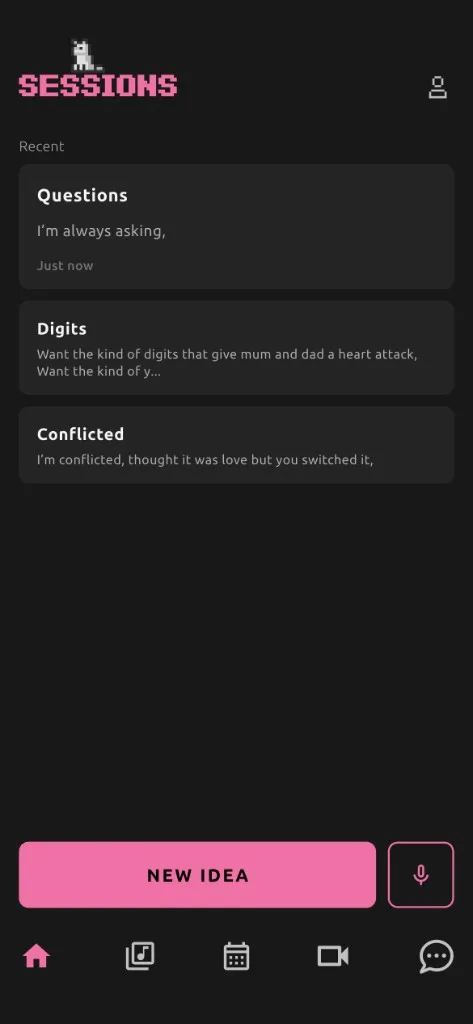
Sessions
A connected creative environment for the full lifecycle of a song, from the first unfinished thought through writing, recording, collaboration, project management and release.
- Mobile App Development
- Product Design
- AI Development
- Native Audio
Mobile app design and development work best as one product, so the experience people approve is the one they can actually use.



09
How we work
We work as a mobile app development agency that treats the application as a product, not a feature list. The useful test is whether someone can complete the important task on a phone they already own, and whether the business can operate what happens afterwards.
You can expect custom mobile app development, a considered choice between iOS, Android, native and cross platform, and a build that includes the backend and integrations the product actually needs. If you are comparing mobile application developers, ask whether the conversation starts with users and operations, or with a technology preference.
Start a project
Start your mobile app development project
Have an idea for a mobile application, or an existing app that no longer fits the business? Speak to our mobile app developers about the users, the platforms and a realistic path from plan to a product people will keep opening.
FAQ
Frequently asked questions about mobile app development
Mobile app development is the process of designing, building, testing and maintaining software for mobile devices. It can include iOS, Android or both, plus backend services, accounts, payments, notifications and integrations.
It is a different brief from a website. The product has to work as an application people install or open on a phone, with the constraints and habits of that device.
Cost depends on the number of platforms, the depth of custom functionality, accounts, payments, backend work and integrations. A focused first release costs less than a product with several user types, subscriptions and multiple external systems.
A clear picture of what users must be able to do is the only reliable way to price the work.
Timelines follow scope, platform choice, custom features, integrations and the amount of design and testing required.
A contained product can move more quickly than a rebuild of a live app with existing users, data and store listings. We set a schedule once the scope is agreed.
Yes. Applications can be developed for iOS, Android or both.
The choice depends on your audience, the device features you need, budget and how you expect to maintain the product.
Cross platform app development builds an application for more than one mobile operating system using a shared approach.
It can reduce duplicated work and simplify maintenance where the product does not need deep, platform specific behaviour.
Native app development builds an application for one mobile operating system, with closer access to that platform's features, performance characteristics and interface conventions.
It is often suitable where hardware access, responsiveness or a highly platform specific experience matters.
Yes. Many apps need backend services for accounts, data, business logic and integrations.
That backend can be developed with the mobile application as part of the same project.
Yes. Apps can share accounts, content, bookings and other data with a website or with CRM, ecommerce and internal systems, usually through APIs.
The options depend on the systems you already use and how reliable those connections need to be.
Yes, where the commercial model and the app stores allow it. That can include card payments, subscriptions, recurring billing and related account flows.
The implementation depends on the platform, the type of payment and how the wider product works.
Yes. Existing applications can be redesigned, extended or redeveloped to improve performance, usability, maintainability and the features people actually need.
The starting point is what the current app fails to do, and which parts of it are still worth keeping.