
AI development
AI Development
AI development is the work of designing and building software that uses artificial intelligence to complete a specific task: finding information, reading documents, drafting a response, classifying a record, or moving a workflow forward.
AI development built around a defined task and approved information
We work with businesses that are evaluating a practical use case, not a general promise. That includes teams with too much repetitive administration, too many documents, slow support, or software that cannot yet use the knowledge the organisation already holds.
Our AI development services cover use case definition, feasibility, prototypes, application development, integration, evaluation and the improvement that follows launch. The emphasis is the AI itself. A wider internal system belongs with custom software development. A subscription product belongs with SaaS development. A public website is a different brief.
01
What custom AI development is, and how businesses can use it
Custom AI development starts from the work, the data and the decision a person still has to make. The software is then built so a model can assist that task under clear limits: what it may read, what it may produce, and when a person must review the result.
Artificial intelligence development is useful when the volume or the variation of the work makes a fixed rule set awkward. Support questions that are similar but not identical, documents that follow a pattern but not a template, and internal knowledge that exists but cannot be found quickly are typical cases. A chatbot, an assistant or an agent is only one interface. The useful part is the task underneath.
AI software development is for organisations that need this behaviour inside a product or a process, not as a separate experiment that staff will not use. AI developers have to choose the model, the data the model may see, and the software around it so the result can be checked, logged and improved.
02
The problems that make an AI project worth considering
High levels of repetitive administration are a common starting point. People copy information between systems, extract fields from documents, or answer the same class of question with slight variations. Manual data extraction and disconnected workflows make that slower, and they make errors harder to see.
Large volumes of documents create a different constraint. The information exists, but finding the relevant passage, comparing versions or pulling structured data from unstructured files takes longer than the decision itself. Poor access to internal knowledge shows up the same way: employees spend too much time searching, or they ask a colleague because the system cannot answer from approved material.
Slow customer support processes often sit on top of both problems. The answer may already be in a policy, a previous case or a product document, but the person handling the request cannot reach it quickly. Existing software that lacks intelligent functionality leaves that search and drafting work outside the system. Some businesses are also unsure whether an AI concept is technically viable. That uncertainty is a reason to test a narrow use case, not a reason to build a large product first.
03
What AI can change, and what it should not be asked to promise
A well scoped application can reduce repetitive work, improve access to information and accelerate document processing. It can support customer service teams by drafting replies, retrieving the relevant policy, or classifying a request so the right person sees it. Employee productivity can improve when people spend less time searching and more time deciding.
The same approach can create an intelligent product feature, automate part of a workflow, or become the basis of a new AI enabled digital product. Those are realistic aims when the task is defined, the source material is available, and someone is responsible for reviewing the cases that matter.
They are not a promise that AI will remove staff, guarantee savings, or produce a perfect result every time. A model can be wrong, incomplete or confidently unsupported by the source. Custom AI solutions are justified when the business can use an imperfect assistant inside a controlled process, and can measure whether that process is better than the one it replaces.
04
Generative AI, language models, agents and assistants
Generative AI development uses models that can produce text, summaries, classifications or structured data from a prompt and a set of supplied context. Large language model development, including LLM development for a specific product, is usually a matter of selecting a suitable model and constraining how it is used, rather than training a new model from scratch.
An assistant or a chatbot is a conversation placed over that capability. It is useful when the person needs to ask a question, receive a draft, or be guided through a known process. AI chatbot development should make the limits visible: what the system can answer, what it will refuse, and when it should hand the conversation to a person.
AI agent development goes a step further. An agent can take a sequence of actions, such as retrieving a record, calling an API, or preparing a result for approval, rather than only replying in a chat. That is valuable for a bounded workflow. It is a poor fit for an open ended task where the system is allowed to decide its own goals. Prompt design, context management and structured outputs are what keep both assistants and agents inside the job they were given.
05
Documents, knowledge, search and workflow automation
Intelligent document processing and data extraction turn files into records a system can use: fields, categories, summaries and exceptions. Classification can route a document or a request. Recommendation systems can suggest a next article, product or action where the business has enough history to support that suggestion. Natural language processing is the broader set of techniques for reading and organising language, of which a language model is one option.
Knowledge systems and intelligent search are for organisations whose answers already exist but cannot be found. A common approach is retrieval over approved documents, often described as RAG. Passages are represented so similar meaning can be found, sometimes through embeddings and vector search, and those passages are given to the model before it answers. The model is then answering from retrieved material, not only from general training.
AI automation development and AI workflow automation belong in the same plan. The useful automation is specific: when a document arrives, extract the fields; when a question is asked, retrieve the policy; when a case is classified, notify the right queue. AI integration services connect that behaviour to the software people already use, so the result lands in the record rather than in a separate chat window.
06
AI development services
We provide AI development services for organisations that need a defined capability, not a general demonstration. Typical work includes:
- AI agents, assistants and chatbots
- Generative AI and language model applications
- RAG, intelligent search and knowledge systems
- Document processing, data extraction and classification
- Recommendation systems and natural language processing
- AI automation and workflow support
- AI enabled software, SaaS features and integrations
Where the AI feature sits inside a subscription product, SaaS development is the related brief. Where the surrounding system is the larger piece of work, custom software development is the better fit. A phone based interface can sit with mobile app development.
07
AI powered software, products and proofs of concept
AI powered software development places the model inside an application people already have a reason to open. That can be a customer portal, an internal tool, or a new product. AI product development and AI SaaS development follow the same rule: the AI has to earn its place in a workflow a customer or employee will repeat.
AI MVP development and a proof of concept are how a business tests viability before a larger build. A useful prototype answers a narrow question. Can the model extract these fields accurately enough? Can it retrieve the right passage from this document set? Can a support draft be reviewed and sent faster than the current process? If the answer is no, that is a useful result. If the answer is yes, the next work is integration, permissions and the operating process around the model.
Model selection sits in that plan. A larger model is not automatically the right one. Latency, cost, data handling and the need for a reliable structured result often matter more than a more fluent reply. APIs connect the application to the model and to the systems that hold the records. The software around the model is what makes the feature maintainable.
08
Security, review, evaluation and ongoing improvement
Security and data access have to be designed with the information the system will see. Permissions should follow the organisation: a person, or a model acting for them, should not retrieve material they are not allowed to read. Customer data, personal information and confidential documents need a clear decision about where they are processed and what is retained.
Hallucination risk is a design concern, not a footnote. A model can produce a plausible answer that is not supported by the retrieved source. Human review is the right control where the consequence of a wrong answer is material: customer commitments, financial figures, legal or clinical wording, and any output that will be treated as a record. Evaluation should measure the task, not the impression of fluency: accuracy against source material, refusal when the answer is not available, and behaviour on the cases staff actually see.
Cost and performance optimisation follow from how often the system runs, how much context it sends, and whether a smaller or more constrained approach would do the same job. Ongoing AI improvement then keeps the application aligned with new documents, changed processes and the failures evaluation has already found. Website maintenance can sit alongside that where the wider digital estate needs the same continuity.
Process
Our AI development process
Discovery and use case definition
We start with the task, the people who do it, and what a useful result would change. That decides whether AI is the right approach at all.
Feasibility and planning
We look at the available data, permissions, model options and the points where a person must review the output before a build is committed.
Prototype or proof of concept
We test the narrow question that matters, using real or representative material, so the business can see what the approach can and cannot do.
Application development and integration
We build the application or feature, connect it to the required systems, and constrain what the model can read, produce and act on.
Evaluation and testing
We evaluate accuracy, refusals, permissions and the journeys staff or customers will actually use, including cases where the model should not answer.
Deployment and ongoing optimisation
We release the capability into use, then improve it from measured results, new source material and changes in the workflow.
Selected work
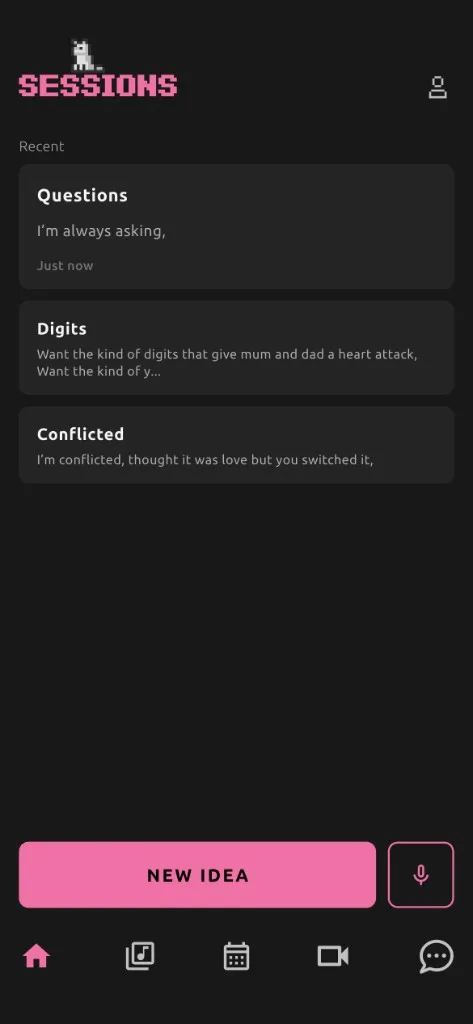
Sessions
A connected creative environment for the full lifecycle of a song, from the first unfinished thought through writing, recording, collaboration, project management and release.
- Mobile App Development
- Product Design
- AI Development
- Native Audio
An AI feature is only useful if it completes a defined task on approved information, and a person can check the result when it matters.



09
How we work
We work as an AI development agency that treats the model as one part of a system, not as the product by itself. The useful test is whether the task is completed more reliably than before, on information the organisation is allowed to use, with a clear path for review.
You can expect custom AI development, a considered choice of model and data access, and software that can be evaluated after launch. If you are comparing AI software developers or an AI development company, ask whether the conversation starts with the task and the source material, or with a claim about what AI can do in general.
Start a project
Book a free AI teardown
Have an AI use case, a product idea, an automation opportunity, or existing software that needs an intelligent feature? Book 45 minutes and we will map one workflow, cost it, and tell you whether AI is worth building before you commit a penny.
FAQ
Frequently asked questions about AI development
AI development is the process of designing and building software that uses artificial intelligence to complete a defined task.
That can include assistants, agents, document processing, search over business information, classification and features inside an existing product. The work includes the model, the data it may use, and the software around it.
AI development services cover the planning, prototyping, building, integration and improvement of those applications.
They can include generative AI, language model applications, chatbots, workflow support and the evaluation needed to see whether the approach is good enough for the task.
Cost depends on the task, the volume and sensitivity of the data, the integrations required, and whether the work is a proof of concept or a production feature.
A narrow prototype costs less than a system with permissions, human review and connections to several existing tools. Ongoing model usage is a separate operating cost from the build.
Timelines follow the clarity of the use case, the state of the source material, and how much surrounding software has to be built or connected.
A focused proof of concept can move more quickly than a production feature with accounts, permissions and review. We set a schedule once the task is defined.
Generative AI development builds software that uses a model to produce or transform content, such as a summary, a draft, a classification or a structured extract.
The useful work is to constrain that output with the right context, source material and review, rather than to let the model answer from general knowledge alone.
An AI agent is software that can take a sequence of actions toward a defined task, such as retrieving information, calling another system and preparing a result for approval.
It is most useful when the actions and the limits are known in advance. It is a poor fit for an open ended job with no clear stop.
Yes. A custom chatbot or assistant can be built to answer from approved information, guide a known process, or draft a response for a person to review.
It should make its limits clear, including when it should refuse or hand the conversation to someone else.
Yes. AI features can be connected to existing systems through APIs and other integration methods, so results can be written back to the record people already use.
The options depend on what those systems expose and how the result needs to be checked before it is treated as final.
Yes, where that data can be made available under the right permissions.
The system should only retrieve or process information the relevant user is allowed to see. What is stored, where it is processed and how long it is kept should be decided before the application is used with live material.
Yes. AI applications usually need continued work after launch.
That can include evaluation against new cases, changes to source material, model updates, cost and performance work, and adjustments when the workflow changes.